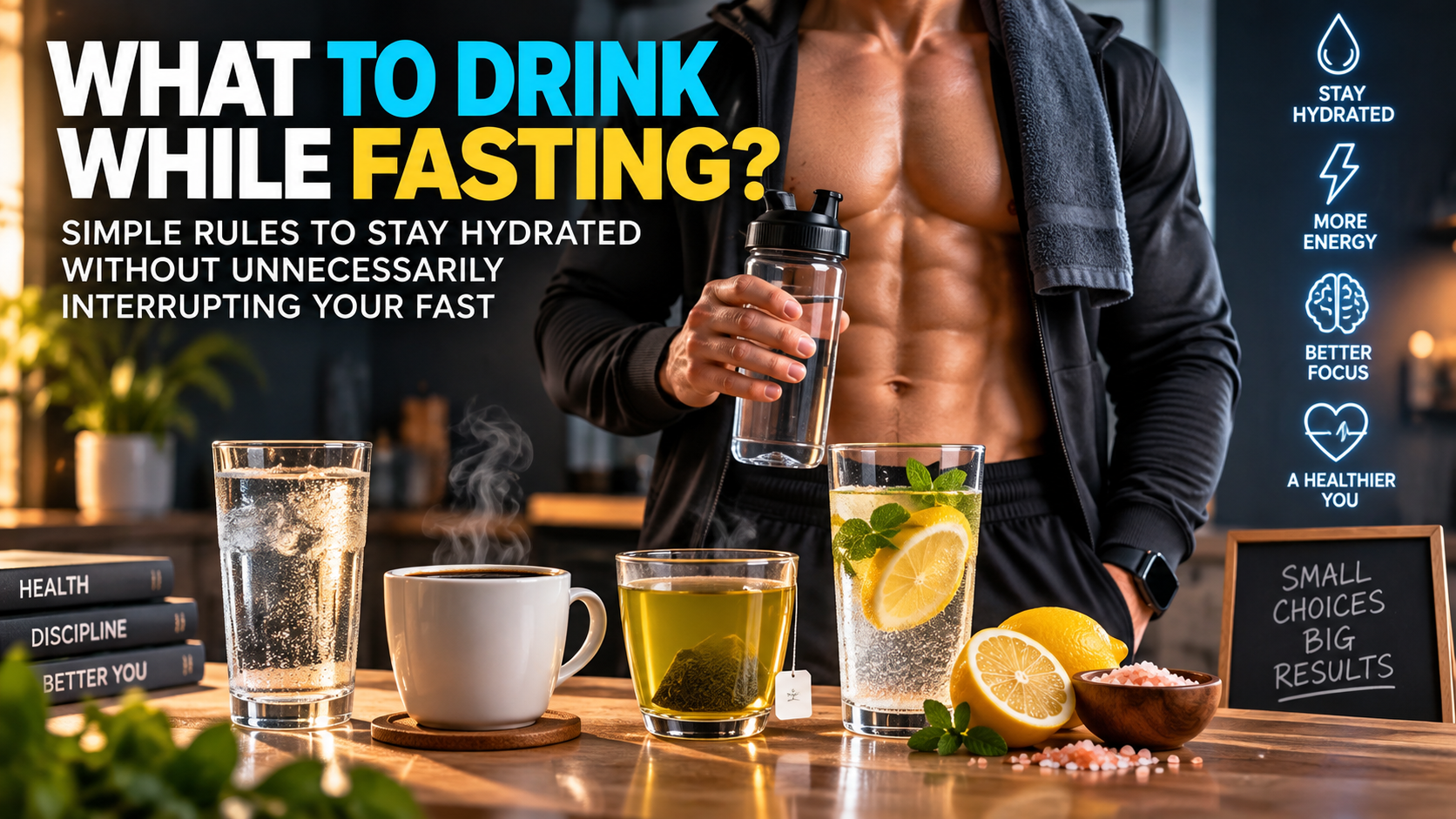
Have you ever wondered what you can actually drink while you’re fasting?
Because once you start fasting, you suddenly realize there are so many different opinions. You start asking yourself: Can I drink this? Can I have coffee? What about tea? Can I add lemon? What about electrolytes? What about apple cider vinegar? What is actually allowed, and what could potentially interfere with the fasting period?
And honestly, this is where many people get confused.
Sometimes we think fasting simply means eating less. Other times, we think that as long as we’re not eating solid food, absolutely anything we drink is fine.
But it’s not quite that simple.
So today, I want to walk you through what fasting actually means, what you can drink during a fasting period, what you may want to avoid, and how to approach the whole process without making it unnecessarily complicated.
First, let’s quickly clarify what fasting means.
When we talk about eating, there are essentially two periods: a period when you’re consuming food and a period when you’re not consuming food.
Both periods matter.
During the eating period, you’re providing your body with energy and nutrients. During the fasting period, you’re simply giving your digestive system a break from food intake and allowing your body to use stored energy.
But here’s something important.
Not every period without food should automatically be considered a special metabolic intervention.
If you haven’t eaten for two or three hours, that’s simply a normal gap between meals for most people. As the fasting period gets longer, different physiological changes can occur, but the exact timing and magnitude of those changes can vary considerably from person to person.
That’s why it’s important not to treat a specific number of hours as a magical threshold.
So what should you actually do while you’re fasting?
The simplest rule is this:
Don’t eat.
But you can drink.
The question is: what?
And that’s exactly what we’re going to cover.
One of the most important things to understand is that the potential benefits of fasting are not simply determined by how many hours you go without food.
What you eat during your eating window matters enormously.
You could fast for many hours and then spend the rest of your day eating mostly ultra-processed foods, large amounts of added sugar, very little protein, and very little fiber.
In that situation, simply extending the fasting period isn’t going to magically turn an otherwise poor dietary pattern into a healthy one.
The bigger picture matters.
Fasting has been studied in relation to body weight, appetite regulation, glucose metabolism, cardiovascular risk factors and other aspects of metabolic health. But the evidence varies depending on the type of fasting, the person, the duration and the outcome being measured.
And some of the more dramatic claims you hear online go far beyond what has actually been demonstrated in humans.
Autophagy is a good example.
It’s a real biological process, and fasting can influence pathways involved in cellular recycling. But we still don’t have a simple human rule saying, “At exactly this number of fasting hours, autophagy suddenly turns on.”
So be careful with anyone presenting fasting as a guaranteed biological switch.
Now let’s talk about some of the most common misconceptions.
Some people say fasting automatically causes gastritis.
That’s not a universal rule.
Someone who already has digestive symptoms may feel worse when they go without food, but that doesn’t mean fasting itself automatically causes gastritis.
The same applies to the idea that everyone will faint during a fast.
A healthy person who is accustomed to going without food may tolerate a fasting period quite differently from someone who has an underlying medical condition, takes certain medications, has problems regulating blood glucose, or is simply not accustomed to fasting.
And this is why individual circumstances matter.
Now let’s get into the practical rules.
If your goal is to maintain a strict fast, the simplest approach is to choose beverages that contain little or no energy and don’t provide meaningful amounts of carbohydrates, protein or fat.
The more calories and nutrients you add, the more you’re moving away from a strict fasting state.
So let’s start with the obvious things you generally want to leave out.
Sugary beverages are out.
Fruit juice is out.
Sweetened coffee is out.
Sweetened tea is out.
Smoothies are out.
Milk and cream add calories and nutrients, so they are no longer consistent with a strict zero-calorie fast.
And the same applies to protein drinks.
A protein shake is food in liquid form. It contains amino acids and calories, so it belongs in your eating period, not your fasting period.
The same applies to bone broth.
Bone broth is often promoted online as something you can consume during a fast without breaking it.
But if you’re trying to maintain a strict fast, bone broth isn’t really a zero-calorie beverage. Depending on how it’s prepared, it can contain protein, amino acids, fat and calories.
So if you’re using bone broth, think of it as part of your eating period or as something you consume when you’re breaking the fast, rather than treating it as a completely neutral fasting beverage.
Now let’s talk about fruit.
You don’t need to eat fruit or drink fruit juice during a fast.
Even if something is natural, that doesn’t automatically make it appropriate for a strict fasting period.
Fruit contains carbohydrates and natural sugars.
Whole fruit can absolutely be part of a healthy diet, but that doesn’t mean it’s compatible with a strict zero-calorie fast.
The same applies to vegetable juices.
They’re nutritious foods for many people, but they’re still providing energy and nutrients.
So if you’re fasting, save them for your eating window.
Now we come to one of the most debated topics: lemon.
A small amount of lemon juice diluted in a large amount of water provides very few calories.
For someone following a practical fasting routine rather than a laboratory definition of fasting, a small amount may be insignificant.
But if your goal is an absolutely strict zero-calorie fast, plain water is the simplest choice.
And that brings us to the most important beverage during fasting:
Water.
Hydration is extremely important.
When you’re not getting fluids from food, especially if you’re fasting for a longer period, paying attention to hydration becomes even more important.
How much water you need varies depending on your body size, activity level, climate, diet and individual circumstances.
There’s no single number that works perfectly for everyone.
You can drink plain water throughout your fasting period.
And if you’re doing prolonged fasting or exercising heavily, electrolytes may become relevant.
But here’s another important distinction:
Not every electrolyte product is compatible with a strict fast.
Some contain sugar, carbohydrates or other calories.
So if you’re using electrolytes, check the nutrition label.
Look at the calories, carbohydrates, sugars and other ingredients.
Don’t assume that something labeled “electrolytes” automatically means zero calories.
Now let’s talk about apple cider vinegar.
A small amount diluted in water is commonly used by people during fasting.
However, it isn’t necessary for fasting, and the evidence doesn’t justify treating it as a magical fasting tool.
If you like it and tolerate it well, a small diluted amount may be acceptable for some people.
But plain water is perfectly sufficient for hydration.
And if you have digestive sensitivity, reflux or other gastrointestinal problems, acidic drinks may not feel good.
Again, individual tolerance matters.
Now let’s talk about herbal infusions.
Unsweetened herbal tea can generally fit very easily into a fasting routine.
You could have something like rosemary, mint, chamomile or other unsweetened herbal infusions.
The important part is that you’re not adding sugar, honey, syrups or other caloric ingredients.
The same basic principle applies to traditional tea.
Green tea, black tea and other unsweetened teas contain very few calories and can be used during a practical fasting period.
And then there’s coffee.
Black coffee is one of the most common fasting beverages.
If you’re drinking plain coffee without sugar, milk, cream or flavored syrups, the calorie contribution is very small.
But there’s an important point here.
More isn’t necessarily better.
If you drink large amounts of coffee during a fast, especially if you’re sensitive to caffeine, you may experience anxiety, shakiness, stomach discomfort, headaches or sleep problems.
And if fasting already makes you feel unwell, adding large amounts of caffeine probably isn’t the solution.
So use common sense.
Black coffee can fit into a fasting routine, but you don’t need to turn your fasting period into a caffeine competition.
The same general idea applies to tea.
Unsweetened tea can be part of your fasting period, but pay attention to caffeine if you’re drinking multiple cups.
Now, what about artificial sweeteners?
This is where things become more complicated.
Some people argue that artificial sweeteners don’t matter because they contain little or no calories.
Others point to research suggesting that certain sweeteners may influence appetite, glucose responses or other metabolic pathways in some circumstances.
The evidence isn’t simple enough to say that every sweetener behaves exactly the same way in every person.
That’s why, if your goal is to make your fasting routine as simple and conservative as possible, you don’t really need them.
Water, unsweetened tea and plain coffee are enough.
You don’t need to make fasting into a chemistry experiment.
And this is especially important when you’re using products that contain sugar alcohols or multiple additives.
Some of these ingredients can also cause digestive symptoms in certain people.
So instead of asking, “Can I technically drink this without breaking my fast?” ask another question:
“Do I actually need it?”
If the answer is no, keep it simple.
Now let’s talk about what you should focus on once your fasting period is over.
This is arguably more important than obsessing over the perfect fasting beverage.
When you break your fast, think about the quality of your overall meal.
You don’t need to immediately eat a huge amount of food simply because you’ve been fasting.
Start with a balanced meal.
Include a good source of protein.
Include vegetables or another source of fiber.
Include healthy fats according to your nutritional needs.
And include carbohydrates if they fit your overall dietary pattern.
You don’t need to be afraid of carbohydrates.
The bigger issue is the overall quality, quantity and context of the food you’re eating.
If you’ve only fasted for 14, 16 or 18 hours, there’s generally no reason to treat breaking the fast as if you’re coming out of a multi-day fast.
The longer the fast, however, the more important it becomes to be cautious, especially if you’re doing extended fasting.
After a prolonged fast, suddenly consuming a very large meal can cause significant gastrointestinal discomfort, and prolonged fasting can carry risks that don’t apply to ordinary overnight fasting.
That’s another reason extended fasting shouldn’t be treated casually.
For most people, a simple overnight fasting period is much easier to integrate into everyday life.
And remember something else:
Fasting isn’t a competition.
Going longer isn’t automatically better.
You don’t get extra points because you managed to go 24, 30 or 40 hours without eating.
What matters is whether the strategy fits your health, your lifestyle, your nutritional needs and your goals.
And there are people who should not fast without professional guidance, including children and adolescents, people who are pregnant or breastfeeding, people with certain medical conditions, people with a history of eating disorders, and people taking medications that can affect blood glucose or blood pressure.
If you’re in one of those situations, fasting shouldn’t be something you experiment with casually.
For everyone else, the basic principles are actually quite simple.
During a practical fasting period, prioritize water.
Unsweetened tea can be an option.
Plain coffee can be an option.
Avoid sugar, juice, milk, cream, protein shakes, smoothies and other calorie-containing beverages if your goal is a strict fast.
Be cautious with sweeteners and heavily processed “zero-calorie” products.
And don’t forget that what happens during your eating window matters just as much, if not more, than simply extending the fasting window.
The goal isn’t to find the most extreme fasting protocol.
The goal is to build a routine you can actually maintain.
Because fasting should not become another source of stress.
It should be a tool that fits into your overall lifestyle.
Keep your hydration adequate.
Choose your beverages intentionally.
Don’t obsess over tiny amounts of calories.
And most importantly, focus on the quality of the food you consume when you actually eat.
Because ultimately, your health isn’t determined by one fasting window.
It’s determined by the pattern you repeat over time.
So keep it simple.
Water.
Unsweetened tea.
Plain coffee if you tolerate caffeine well.
Avoid caloric drinks during the fasting period.
And when it’s time to eat, focus on real, nutritious food and a balanced meal.
That’s a much more sustainable approach than constantly searching for another fasting hack.
The goal isn’t simply to go without food.
The goal is to understand what you’re doing, why you’re doing it, and how it fits into the bigger picture of your nutrition and lifestyle.