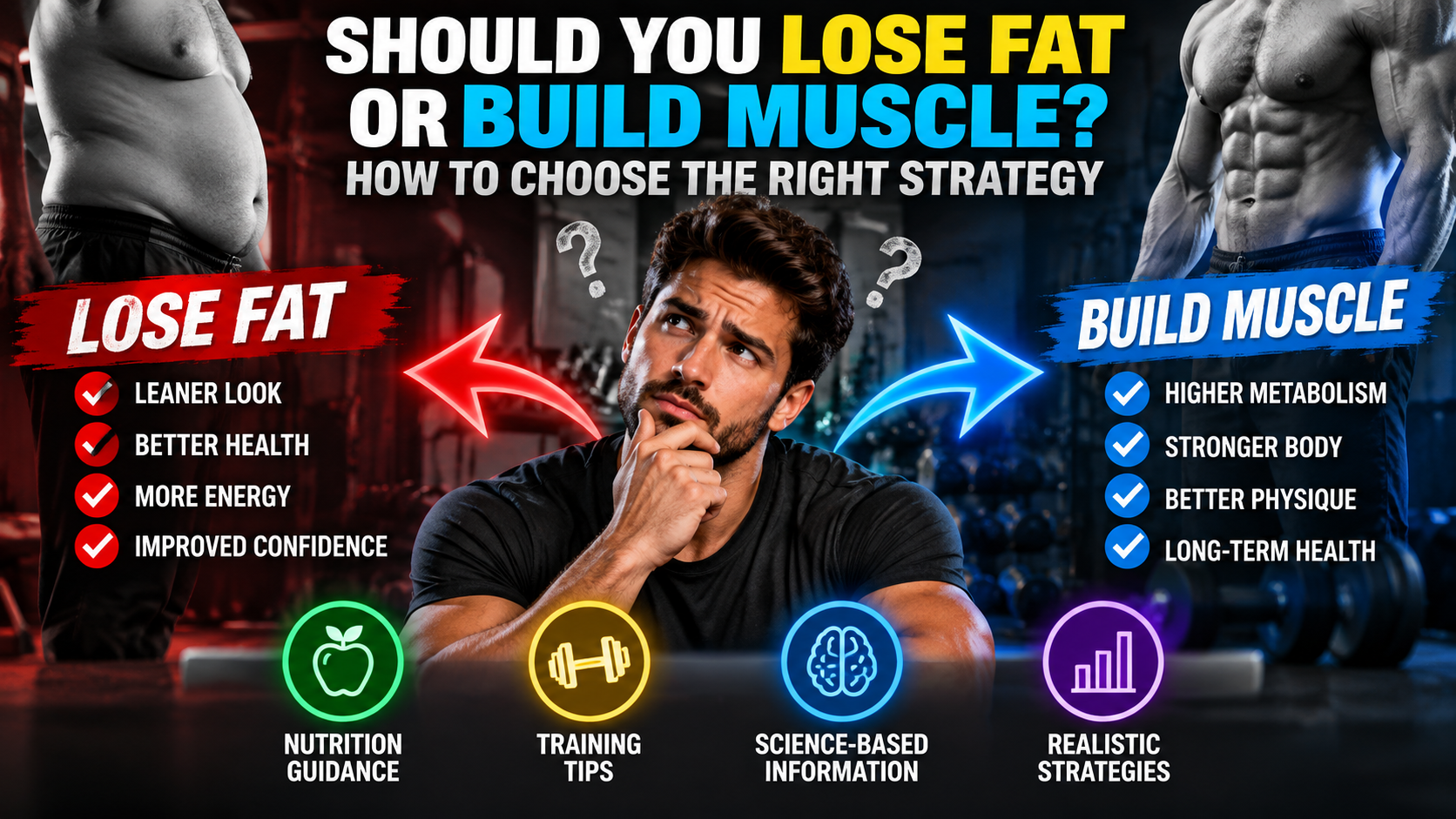
If you have relatively thin arms and legs but tend to carry more fat around your abdomen or chest, you may have wondered:
Should I keep losing fat, or should I start building muscle?
Online, you will often find two simple answers: “Go into a calorie deficit” or “Start bulking.”
But choosing the wrong approach can leave you simply weighing less without looking significantly more muscular or athletic. On the other hand, gaining weight too quickly can lead to unnecessary fat gain without building the physique you are looking for.
So, what should you do first?
The answer depends on more than your body weight. Your starting point, training experience, goals, performance, waist measurements, and how your body responds over several weeks can all help determine the most appropriate approach.
There is no universal rule that says everyone who carries extra fat should diet or that everyone who is relatively thin should start a bulk.
Important: This article provides general educational information and does not replace individualized advice from a qualified healthcare or fitness professional.
Five Factors to Consider Before Choosing a Strategy
Before deciding whether to lose fat, gain muscle, or attempt body recomposition, consider these five factors:
- How much body fat do you have and where is it distributed?
- What is happening to your waist measurement?
- How much training experience do you have?
- What do you want to change first?
- How are your strength, recovery, and performance changing?
These factors provide a much better starting point than simply looking at the number on the scale.
When Losing Fat May Make More Sense
If you have a significant amount of excess body fat and your primary goal is to reduce it, a gradual calorie deficit may be appropriate.
The objective should not be to lose weight as quickly as possible.
An excessively aggressive deficit can make it more difficult to maintain training performance, recover properly, and preserve lean mass.
Instead, a moderate approach combined with resistance training and adequate protein can help support muscle retention while reducing body fat.
Why Does the Rate of Weight Loss Matter?
Faster weight loss is not automatically better.
Research involving athletes has found that slower rates of weight loss can provide advantages for preserving lean mass and maintaining performance compared with more aggressive weight-loss approaches.
This does not mean that everyone needs to lose weight at exactly the same rate.
Individual circumstances matter.
The main principle is that the calorie deficit should be sustainable and should not unnecessarily compromise your training, recovery, or nutritional needs.
Strength Training During Fat Loss
If you are trying to lose body fat, resistance training can be an important part of your plan.
The goal is not necessarily to build a large amount of muscle while dieting.
Instead, strength training provides your muscles with a stimulus that can help preserve lean mass while you lose weight.
A good program should include progressive resistance training, adequate recovery, and sufficient protein.
What About Protein?
Protein is particularly important during periods of calorie restriction because adequate protein intake, combined with resistance training, can support the maintenance of muscle mass.
Your individual protein needs depend on factors such as body weight, training status, age, health, and overall diet.
When Building Muscle May Make More Sense
Now consider the opposite situation.
You are relatively lean, have limited muscle mass, train consistently, and your main goal is to look bigger and more muscular.
In this case, continually trying to make the number on the scale smaller may move you further away from your goal.
A muscle-building phase may make more sense.
However, building muscle does not mean eating as much as possible.
Why You Should Avoid an Excessive Calorie Surplus
A large calorie surplus can increase body weight quickly, but not all of that additional weight will be muscle.
Some of it can be body fat.
For this reason, a controlled calorie surplus may be preferable when the goal is to gain muscle while limiting unnecessary fat gain.
Your progress can be monitored through:
- Body weight.
- Waist measurement.
- Strength.
- Training performance.
- Progress photographs.
- Recovery.
If your waist is increasing rapidly while your strength and training performance are not improving, your nutrition and training program may need to be reassessed.
The Third Option: Body Recomposition
There is another possibility that is often overlooked when everything is reduced to “cutting” or “bulking.”
It is called body recomposition.
Body recomposition refers to reducing body fat while maintaining or increasing lean muscle mass.
This can be more achievable in certain situations, particularly among:
- Beginners.
- People returning to resistance training after a period away.
- People with a moderate amount of body fat who begin a structured strength-training program.
It is also possible for trained individuals to experience changes in fat mass and lean mass under certain conditions, although the magnitude of these changes varies considerably.
Body Recomposition Is Not Turning Fat Into Muscle
An important clarification is that body fat does not literally transform into muscle.
They are different tissues.
Instead, body recomposition means that body fat decreases while muscle mass is maintained or increased during the same period.
Training, nutrition, protein intake, recovery, genetics, and starting body composition can all influence the result.
You Do Not Need an Exact Body-Fat Percentage
It can be tempting to believe that you need to know your exact body-fat percentage before deciding what to do.
You don’t necessarily need an exact number.
Body-fat measurements can have significant limitations depending on the method used.
Instead, you can combine several indicators.
Your Waist Measurement
Your waist can provide useful information about changes in abdominal fat, but it can fluctuate because of factors such as digestion, hydration, and measurement technique.
Try to measure it consistently under similar conditions.
Your Body Weight
The scale can help identify trends, but it cannot tell you exactly how much of your weight is fat, muscle, water, or glycogen.
That is why body weight should not be interpreted in isolation.
Your Strength
Strength is another useful indicator, but maintaining or increasing strength does not automatically prove that you gained muscle.
Strength can improve because of better technique, coordination, and nervous-system adaptations.
For this reason, it is better to combine strength data with other measurements.
Progress Photos
Progress photographs can help reveal changes that are difficult to notice from day to day.
Try to take them under similar lighting, clothing, distance, and posture.
Six Situations to Consider
Situation 1: You Have More Body Fat and a Large or Increasing Waist
If your main goal is to reduce body fat, a gradual calorie deficit combined with resistance training and adequate protein may be appropriate.
Situation 2: You Are Relatively Lean and Have Little Muscle
If your primary goal is to become bigger and more muscular, a controlled muscle-building phase may be appropriate.
A moderate calorie surplus can provide additional energy for muscle growth while helping limit unnecessary fat gain.
Situation 3: You Are a Beginner or Returning to Training
If you are new to resistance training or returning after a long break, body recomposition may be a realistic possibility.
You may be able to improve strength and build muscle while reducing body fat, particularly when training and nutrition are well structured.
Situation 4: Your Weight Is Staying Similar but Your Waist Is Decreasing
This is an important situation.
If your body weight remains relatively stable while your waist measurement decreases, your strength remains stable or improves, and your progress photographs show positive changes, there may be no reason to automatically reduce your calorie intake.
Your body composition may be improving even though the scale is not changing dramatically.
Situation 5: Your Weight Is Dropping Very Quickly
If your weight is falling rapidly while your training performance and recovery are getting worse, it may be worth reviewing:
- Your calorie deficit.
- Protein intake.
- Training volume.
- Recovery.
- Sleep.
Faster weight loss is not always better.
Situation 6: Nothing Is Changing for Several Weeks
If your weight, waist measurement, performance, and photographs remain unchanged despite consistent adherence, it may be time to reassess your plan.
Rather than changing everything at once, consider adjusting one variable and observing what happens over the following weeks.
The Goal Is Not to Follow a Label
One of the biggest mistakes is choosing a strategy simply because you identify yourself as “skinny-fat,” overweight, thin, or muscular.
Those labels do not tell the entire story.
Two people with the same body weight can have completely different amounts of muscle and body fat.
The better question is:
What needs to change first?
If your priority is reducing excess body fat, focus on gradual fat loss.
If your priority is gaining muscle and you are relatively lean, focus on progressive resistance training and an appropriate nutritional surplus.
If you are new to training or returning after a long break, body recomposition may be a reasonable approach.
How to Know Whether Your Strategy Is Working
Whatever approach you choose, monitor several indicators over time.
Consider tracking:
- Body weight trends.
- Waist circumference.
- Strength and performance.
- Progress photographs.
- Energy levels.
- Recovery.
- Training consistency.
Do not make major decisions based on a single day’s weight or one measurement.
Look for trends over several weeks.
Conclusion
Choosing between losing fat, gaining muscle, or attempting body recomposition is not simply a matter of deciding whether you are “fat” or “thin.”
Your starting body composition, training experience, goals, performance, nutrition, and progress over time all matter.
If you have significant excess body fat, a gradual calorie deficit may be appropriate.
If you are relatively lean and want to increase muscle mass, a controlled calorie surplus may make more sense.
If you are a beginner or returning to resistance training, body recomposition may be a realistic option.
The most important principle is to choose a strategy based on your actual starting point, monitor your results, and make adjustments based on evidence rather than following rigid rules from the internet.
⸻
Frequently Asked Questions
Should I lose fat before building muscle?
Not necessarily. The appropriate approach depends on your current body composition, training experience, and goals.
Can I build muscle while losing fat?
Yes. This can happen under certain conditions, particularly in beginners, people returning to training, and some individuals with higher levels of body fat.
Is bulking necessary to build muscle?
A calorie surplus can support muscle growth, but a large surplus is not necessary. Excessive calorie intake can lead to unnecessary fat gain.
How do I know if I am losing fat?
Changes in waist circumference, body weight trends, photographs, and body composition measurements can provide useful information. No single measurement is perfect.
Why is my weight staying the same while my waist is getting smaller?
This can happen when body composition is changing. For example, you may lose some body fat while maintaining or gaining lean mass.
How long should I follow a fat-loss or muscle-building plan?
There is no universal timeframe. Evaluate your progress over several weeks and make gradual adjustments based on your goals and response.