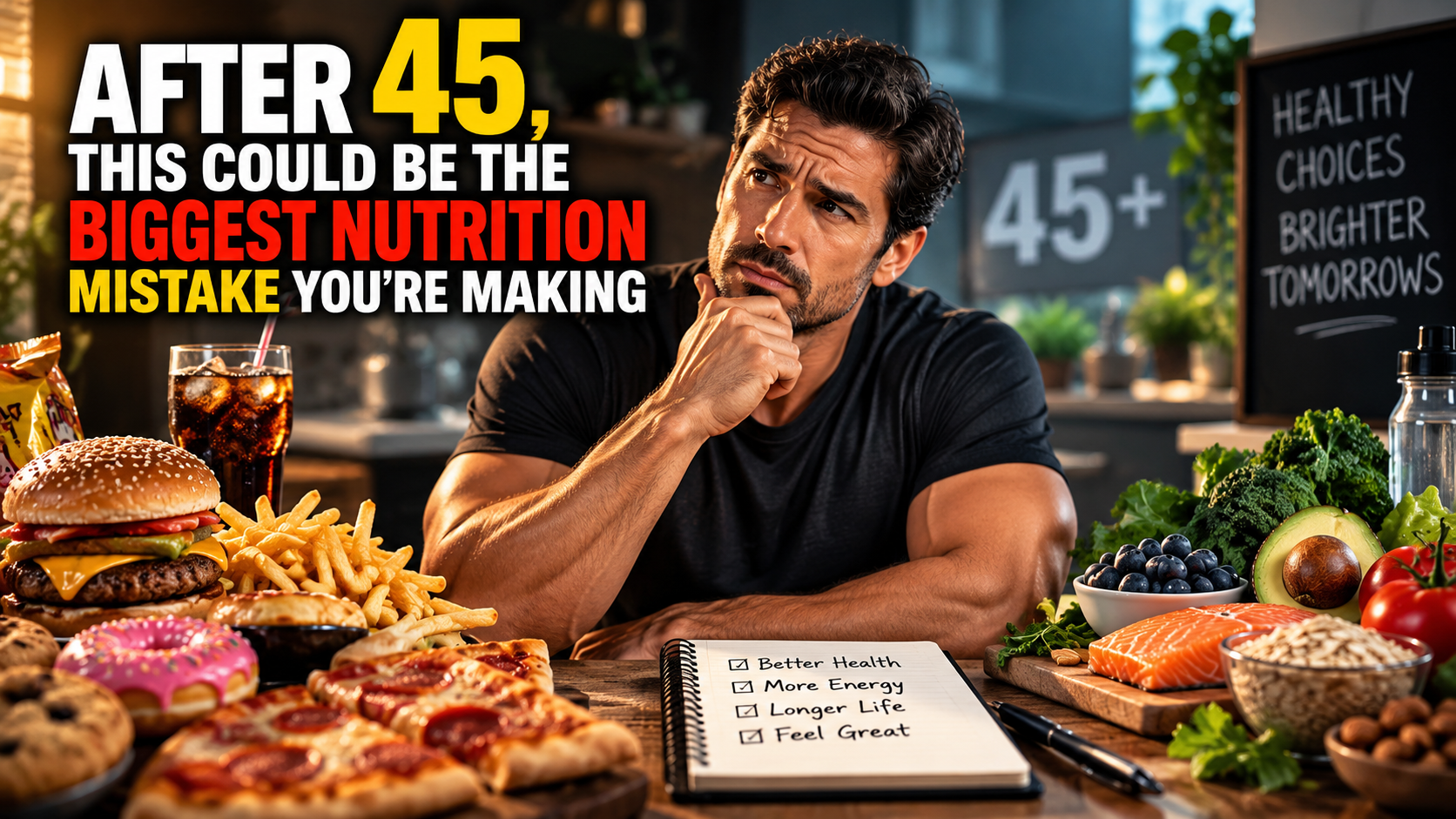
Three years ago, a woman around 50 years old came into my office.
She was intelligent, disciplined, and took excellent care of herself.
She didn’t smoke. She barely drank. She exercised.
And she was convinced she was eating healthy.
For most of her life, she had avoided red meat because she had been told it would damage her kidneys and increase her risk of cancer.
She was afraid of eggs.
She believed too much protein was basically a poison.
So her breakfast was usually fruit with granola.
Lunch was a salad with beans and maybe a tiny piece of chicken.
And dinner wasn’t much different.
She thought she was protecting her health.
But when I looked at her body composition, something immediately caught my attention.
She was already showing early signs of muscle loss.
She was around 50 years old.
And she had very little muscle for her age.
She also complained about low energy and weakness.
And this is where the story becomes important.
Because sometimes what we think is healthy isn’t necessarily what our body needs.
For decades, many people were told that protein was dangerous.
That eating more meat would destroy the kidneys.
That eggs were bad.
That animal protein should be minimized.
But the scientific conversation has become much more nuanced.
And one of the biggest mistakes people can make as they get older is not eating enough protein to maintain their muscle.
Because muscle isn’t just about looking strong.
Your skeletal muscle is one of the most important metabolic tissues in your entire body.
It plays a major role in glucose disposal and insulin sensitivity.
When you progressively lose muscle, your body can become less efficient at handling glucose.
And over time, that can contribute to metabolic problems.
This is why muscle isn’t simply about appearance.
Muscle is part of your health reserve.
It is part of your ability to remain independent.
It is what helps you climb stairs, carry groceries, get up from a chair, play with your grandchildren, and protect yourself when you fall.
And here’s something many people don’t realize.
Muscle loss doesn’t suddenly begin when you’re 70.
Muscle mass generally begins declining gradually in adulthood, and the rate can accelerate with aging.
Eventually, significant loss of muscle and strength can contribute to a condition called sarcopenia.
And that’s why what you do in your 30s, 40s, and 50s matters.
Now let’s talk about what happens after approximately age 45.
Your muscles can become less responsive to the same amount of protein.
Researchers call this phenomenon anabolic resistance.
When you’re younger, a relatively small amount of high-quality protein can strongly stimulate muscle protein synthesis.
As you age, the signal becomes harder to trigger.
It’s almost as if the muscle becomes more stubborn.
And one of the key amino acids involved in this process is leucine.
Leucine helps activate a molecular pathway called mTOR, which plays an important role in regulating muscle protein synthesis.
This is why simply eating tiny amounts of protein throughout the day may not be the best strategy for preserving muscle.
The total amount matters.
But the amount you consume at each meal matters too.
Think about the typical breakfast.
Coffee.
Maybe some toast.
A little fruit.
Perhaps some milk.
And that’s it.
You may have eaten almost no meaningful amount of protein.
Then you repeat the same pattern every morning.
Your muscles aren’t receiving a strong nutritional signal.
And years later, you may wonder why you’re weaker.
Why you struggle to carry things.
Why climbing stairs feels harder.
Why your balance isn’t what it used to be.
Why a small fall can suddenly become a major problem.
Sometimes we blame all of this on age.
But aging isn’t the only variable.
Your lifestyle matters.
Your activity level matters.
And your protein intake matters.
Now comes the question I know many people are asking.
Does eating more protein damage your kidneys?
For healthy people, the evidence does not support the idea that a higher-protein diet automatically causes kidney damage.
But there’s an important distinction.
If you already have chronic kidney disease, your protein intake should be individualized with your healthcare professional.
That’s completely different.
Healthy kidneys and diagnosed kidney disease are not the same situation.
And what about plant protein?
Yes, plant protein absolutely counts.
You can build and maintain muscle while following a vegetarian or even vegan diet.
But you have to pay attention to the total amount and the amino-acid profile.
Many plant proteins contain less leucine per gram than certain animal proteins.
That doesn’t make them useless.
It simply means you may need larger portions or combinations of different plant foods.
For example, combining foods such as beans and rice can help create a more complete amino-acid profile.
The important thing is understanding what you’re actually eating.
Now let’s make this practical.
For many adults over 45, especially those who are physically active or trying to preserve muscle, protein needs may be considerably higher than the old minimum of 0.8 grams per kilogram per day.
A target around 1.2–1.6 grams per kilogram per day is commonly used in research and expert recommendations for many older or active adults, although individual needs vary.
For example, if you weigh 70 kilograms, 1.5 grams per kilogram would be about 105 grams of protein per day.
And you don’t want to eat all 105 grams in one giant meal.
It makes more sense to distribute your protein across two or three meals.
For example, you could aim for roughly 30–40 grams of protein in each main meal, depending on your total daily target.
And here’s what that can look like.
About 100 grams of cooked chicken breast can provide roughly 25–30 grams of protein.
A similar portion of salmon can provide around 20–25 grams.
One large egg provides around 6 grams.
Greek yogurt can add another meaningful amount depending on the brand and serving size.
Beans and lentils provide protein too, but generally require larger portions to reach the same protein target.
The point isn’t that you need to eat steak every day.
The point is that you need to stop being afraid of protein without understanding your actual nutritional needs.
Because there’s another mistake I see all the time.
People focus obsessively on losing weight while completely ignoring muscle.
They eat less.
They move less.
They lose weight.
But they also lose muscle.
The number on the scale goes down, but their physical strength goes down with it.
And that’s not the kind of aging we should be aiming for.
We want to reach 60, 70, 80, and beyond with enough muscle and strength to live independently.
So here’s your challenge for this week.
Take your weight in kilograms.
Multiply it by a protein target appropriate for you, often somewhere around 1.2 to 1.6 grams per kilogram, depending on your age, activity level, goals, and health status.
Then look at what you actually ate yesterday.
Don’t guess.
Write it down.
Breakfast.
Lunch.
Dinner.
Snacks.
Then compare the numbers.
You may discover that the problem isn’t that you’re eating too much protein.
It may be that you’ve been eating far too little for years.
And remember one more thing.
Protein works best when you combine it with resistance training.
Your muscles need both the building blocks and the signal.
Protein provides the raw materials.
Strength training tells your body:
“We need to keep this muscle.”
That’s the combination that matters.
And if you have kidney disease, liver disease, or another significant medical condition, don’t dramatically increase your protein intake without discussing it with your healthcare professional.
The goal isn’t to follow a number blindly.
The goal is to understand your body and make an informed decision.
Because the woman I told you about at the beginning didn’t need another restrictive diet.
She needed better information.
She had spent decades being afraid of foods that could have helped her meet her nutritional needs.
And that is the real lesson.
Sometimes the problem isn’t that you’re eating too much.
Sometimes the problem is that you’ve been afraid to eat enough.
Your muscles don’t care about the diet trend of the month.
They respond to nutrients, movement, recovery, and consistency.
So don’t wait until you’re 70 to start thinking about muscle.
Start now.
Because the strength you build today may be the independence you protect decades from now.
If this information helped you, share this video with someone who has spent years being afraid of protein.
Like the video, subscribe to the channel, and turn on the notification bell so you don’t miss the next one.
Your future body is being built by the decisions you make today.