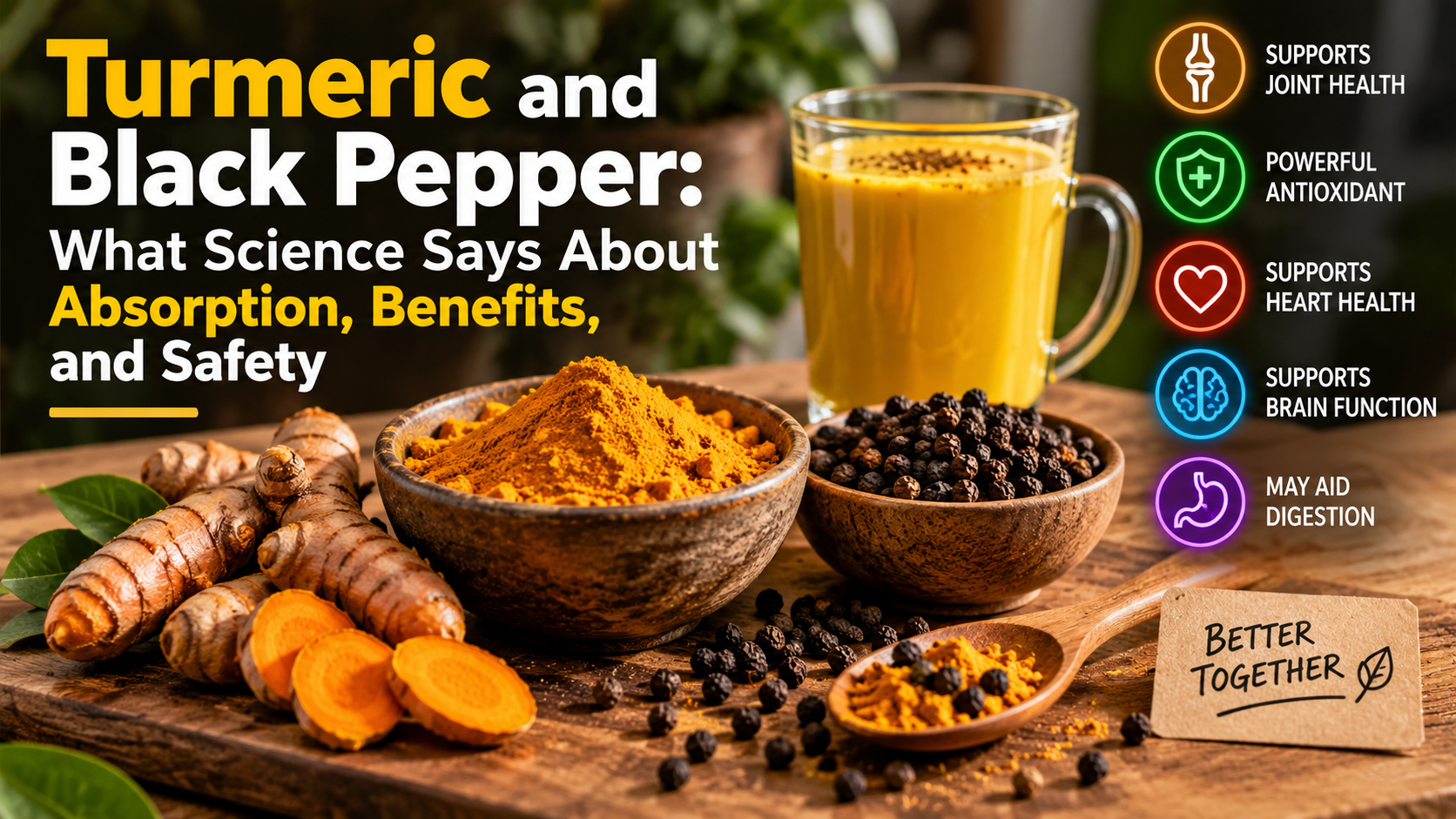
Turmeric has become one of the most popular ingredients in the world of nutrition and wellness. It is commonly added to foods, teas, drinks, and supplements because it contains compounds called curcuminoids, including curcumin.
You may have also heard that combining turmeric with black pepper makes it work better because black pepper contains piperine, a compound that can increase the absorption of curcumin.
But there is an important distinction to understand: increasing absorption does not automatically mean increasing health benefits.
In some situations, higher absorption may be useful. In others, it may also change how the body processes the compound. That is why the dose, formulation, and individual circumstances matter.
What Is the Difference Between Turmeric and Curcumin?
Turmeric is a plant whose underground stem is commonly dried and ground into a yellow-orange spice.
It naturally contains several compounds called curcuminoids. Curcumin is one of the best-known compounds in this group and has been extensively studied.
However, ordinary turmeric powder contains a relatively small proportion of curcuminoids compared with concentrated curcumin supplements.
This means that using turmeric as a culinary spice is not necessarily equivalent to taking a concentrated curcumin product.
Why Is Absorption Important?
One of the challenges researchers have identified with curcumin is its relatively low oral bioavailability.
In simple terms, consuming a compound does not necessarily mean that large amounts of it enter the bloodstream.
Researchers have therefore developed different formulations designed to increase curcumin absorption. Some combine curcumin with other compounds, including piperine, while others use different delivery systems involving lipids or other technologies.
This creates an important question:
If the body absorbs more, does that automatically make the product better?
Not necessarily.
A higher concentration in the bloodstream can change both potential effects and potential interactions. More absorption is not automatically synonymous with better results.
What Does Black Pepper Have to Do With It?
Black pepper contains piperine, a compound that can affect the metabolism and absorption of certain substances.
Research has shown that piperine can increase the amount of curcumin that becomes available in the body.
However, piperine does not interact only with curcumin. It can also influence enzymes and transport systems involved in the metabolism of certain medications.
That is why combining concentrated curcumin with large amounts of piperine should not simply be viewed as a harmless way to make turmeric “stronger.”
People who take prescription medications should be especially careful with concentrated supplements and discuss potential interactions with a qualified healthcare professional.
What Does Research Say About Turmeric?
Curcumin and turmeric have been investigated in numerous areas of health research, particularly because of their biological and anti-inflammatory properties.
One of the areas with considerable research is joint health, including osteoarthritis.
Some clinical studies and systematic reviews have reported improvements in pain or physical function among people with osteoarthritis who used certain curcumin preparations.
However, the results depend on the formulation, dose, duration, and characteristics of the people studied. Results from one formulation cannot automatically be applied to every turmeric supplement available on the market.
What About Liver Health?
This topic requires particular caution.
Although turmeric has a long history of culinary use, cases of liver injury associated with certain turmeric or curcumin supplements have been reported.
The risk appears to be uncommon, but concentrated supplements are different from the small quantities of turmeric normally used in cooking.
Some reported cases involved products formulated to increase curcumin absorption, including products containing piperine.
This does not mean that turmeric is inherently dangerous or that everyone who consumes it will experience a problem. It means that concentrated supplements deserve more caution than ordinary culinary use.
Natural Does Not Always Mean Risk-Free
One of the most important principles to remember with supplements is that “natural” does not automatically mean “risk-free.”
Plants contain biologically active compounds. Those compounds can interact with the body, medications, and sometimes other supplements.
The same principle applies to concentrated extracts.
A spice used in normal cooking and a highly concentrated capsule can expose the body to very different amounts of active compounds.
Can You Still Use Turmeric in Food?
For most people, turmeric as a culinary ingredient is simply part of a normal diet.
It can be used in dishes such as curries, soups, rice dishes, sauces, and other recipes.
Adding a reasonable amount of dietary fat to a meal may also influence the absorption of fat-soluble compounds, which is one reason turmeric is traditionally used in foods containing oils or other sources of fat.
However, culinary use should not be confused with taking concentrated doses for therapeutic purposes.
What About Turmeric and Lemon?
Turmeric is sometimes combined with lemon, ginger, or other ingredients in wellness drinks.
There is a common belief that these combinations dramatically increase the health effects of turmeric. The evidence does not support treating such drinks as a guaranteed health intervention.
A turmeric drink can certainly be part of a balanced diet, but it should not be presented as a substitute for medical treatment or as a cure for a disease.
Who Should Be Especially Careful With Concentrated Supplements?
Extra caution is appropriate for people who:
- Take prescription medications
- Use blood-thinning medications
- Have a history of liver problems
- Are preparing for surgery
- Are pregnant or breastfeeding
- Have several medical conditions
- Are taking multiple supplements at the same time
In these situations, it is reasonable to discuss the specific product and ingredients with a healthcare professional before using concentrated turmeric or curcumin supplements.
The Bigger Lesson About Supplements
The story of turmeric illustrates an important point about nutrition and supplements.
A compound can have interesting biological properties without meaning that the highest possible dose is the best option.
There is a major difference between eating a food and taking a concentrated extract designed to deliver much larger amounts of a specific compound.
When a supplement is marketed as having dramatically higher absorption, that should not automatically be interpreted as proof that it provides dramatically greater health benefits.
The scientific question is more complicated:
Does the increased exposure actually improve meaningful health outcomes, and is the benefit greater than the potential risk?
That is the question that matters.
Final Thoughts
Turmeric remains an interesting and widely studied food ingredient. Curcumin has demonstrated biological activity in laboratory and clinical research, particularly in areas such as inflammation and joint health.
At the same time, concentrated formulations can behave differently from ordinary culinary turmeric. Increasing bioavailability can change how much of a compound reaches the bloodstream and may also change its potential interactions.
The most sensible approach is to distinguish between turmeric as a food, concentrated curcumin supplements, and highly bioavailable formulations.
Instead of assuming that the strongest or most rapidly absorbed product is automatically the best, consider the evidence behind the specific formulation, the amount being used, and your individual circumstances.
Nutrition is rarely about finding the most powerful version of something. Often, it is about understanding how much is appropriate, how it fits into the rest of the diet, and when caution is warranted.