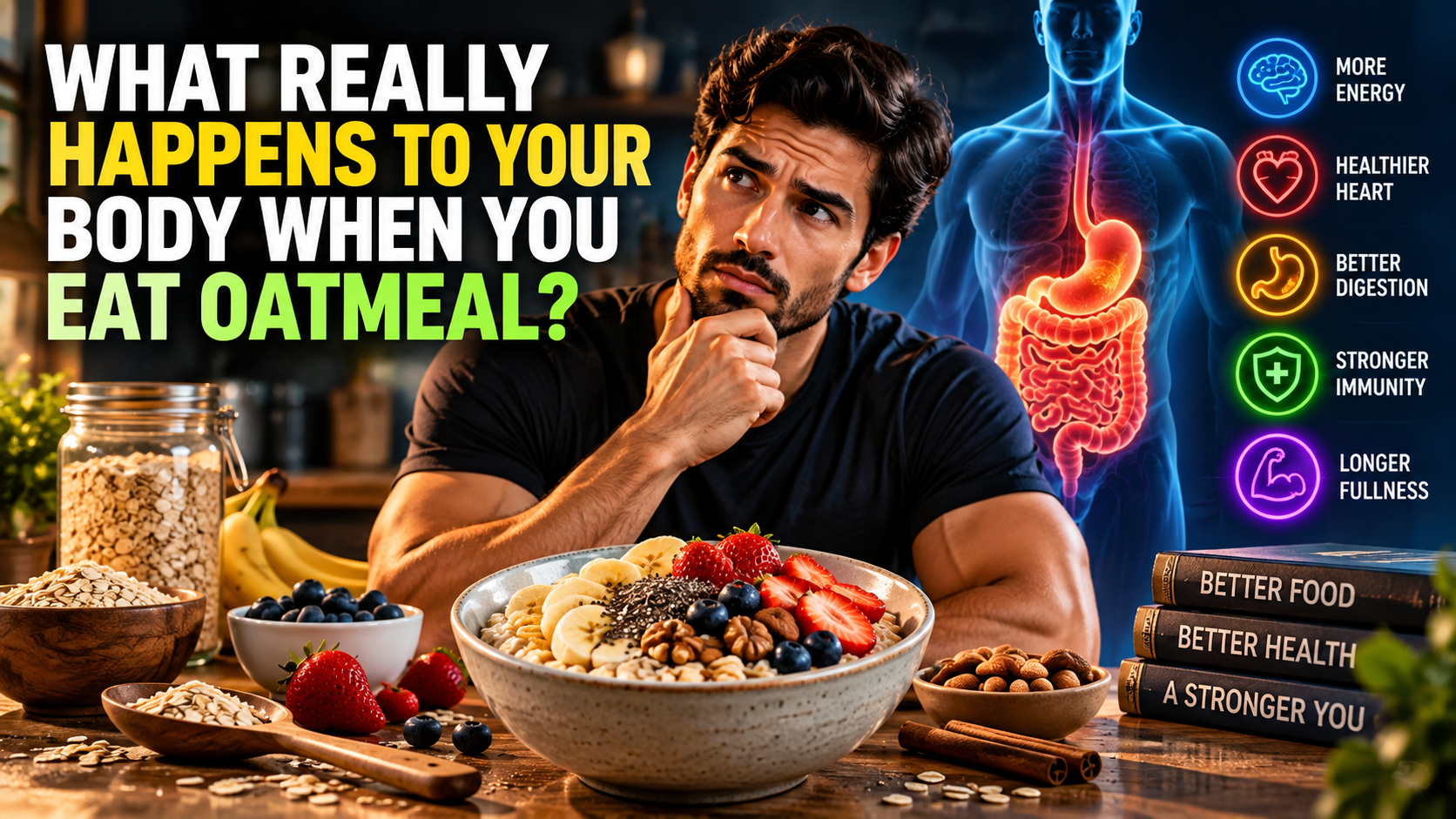
I’m about to tell you something I never thought I would say.
Oatmeal can beat many expensive supplements in some very specific areas.
And the problem is that we’ve been taught to think oatmeal is bad simply because we don’t know how to use it correctly.
Oatmeal can have important effects on your stomach, your intestines, your metabolism, your gut microbiome, your cholesterol, and even your energy levels.
And the crazy part is that you can open social media for five minutes and find people saying the exact opposite.
“Don’t eat oatmeal.”
“Oatmeal is terrible for you.”
“It will spike your blood sugar.”
“It’s food for pigs.”
“Stay away from it.”
So today, I want to show you exactly what happens inside your body when you eat oatmeal.
From the moment it enters your mouth to the moment it reaches your colon.
And I’m warning you right now…
There are two effects at the end that might completely change the way you look at this simple food.
People will tell you that oatmeal is just another grain.
But when you look at its chemistry and biochemistry, something much more interesting happens.
It’s almost like an intelligent sponge.
Oatmeal contains soluble fiber.
And one of its most important components is a type of soluble fiber called beta-glucan.
When beta-glucan comes into contact with water, it forms a thick gel.
And that gel does something very interesting.
It increases the viscosity of the contents inside your digestive system.
In simple terms, it slows things down.
Your stomach receives signals associated with fullness.
Your digestion doesn’t happen as quickly.
And that can help you feel satisfied for longer.
But here’s where people make a huge mistake.
You don’t need to eat an enormous bowl of oatmeal to get the benefits of its fiber.
More isn’t automatically better.
A reasonable amount can be enough to add fiber to a balanced meal.
Because oatmeal isn’t supposed to be something you use to stuff yourself.
It’s a tool.
And when you use it correctly, it can help regulate appetite.
Less hunger.
Fewer cravings.
Better portion control.
And potentially more stable energy throughout the day.
This is why some people say:
“Every time I started adding oatmeal to my diet, I started losing weight.”
But let’s be clear.
Oatmeal doesn’t magically burn fat.
That’s not how biology works.
If you’re eating enormous portions of oatmeal every day, especially with sugar, syrups, sweetened granola, and other highly processed ingredients, you can easily turn a healthy food into a calorie-dense meal.
The benefit comes from how you use it.
Now let’s talk about cholesterol.
This is one of the areas where the evidence for oat beta-glucan is particularly interesting.
Beta-glucan can increase the viscosity of the intestinal contents and interfere with the reabsorption of bile acids.
Your liver uses cholesterol to produce bile acids.
When more bile acids leave the body through the digestive tract, the liver has to use more cholesterol to make new ones.
And that can contribute to lower LDL cholesterol.
That’s one reason oats and oat beta-glucan have been studied for cardiovascular health.
But don’t misunderstand me.
If you have high cholesterol, eating oatmeal doesn’t guarantee that your cholesterol will become normal.
If you have familial hypercholesterolemia, oatmeal isn’t going to erase your genetics.
And if your doctor prescribed medication, oatmeal isn’t automatically a replacement for that treatment.
It’s one piece of the puzzle.
Now let’s talk about blood sugar.
This is where oatmeal gets misunderstood.
Yes, oatmeal contains carbohydrates.
And yes, carbohydrates can raise blood glucose.
But the physiological response depends on the food, the portion, the degree of processing, what you eat with it, and your individual metabolism.
The beta-glucan in oats can slow the digestion and absorption of carbohydrates.
That can help reduce the speed and size of post-meal glucose rises compared with lower-fiber carbohydrate choices.
But if you take a bowl of oatmeal and cover it with sugar, honey, syrup, candy, and a huge amount of dried fruit…
Don’t expect oatmeal to magically cancel everything else.
Your body doesn’t work that way.
The goal isn’t to find one food that protects you from every other food.
The goal is to build a meal that works together.
Oatmeal plus adequate protein.
Oatmeal plus healthy fats.
Oatmeal plus fiber from different sources.
That’s where it becomes much more interesting.
And now we have to go deeper.
Because what happens to oatmeal after the small intestine?
This is where the story changes.
A significant portion of the fiber isn’t completely digested in the small intestine.
Eventually, it reaches your colon.
And when it gets there, your human digestive enzymes aren’t the main characters anymore.
Your gut bacteria are.
They are sitting there waiting for fermentable fiber.
And when they get it, they start producing metabolites that can affect your intestinal environment.
This is where we talk about short-chain fatty acids.
Including acetate, propionate, and butyrate.
Butyrate is particularly interesting because it serves as an important energy source for cells lining the colon and has been studied for its role in maintaining intestinal barrier function and regulating inflammation.
And here’s the beautiful part.
You don’t necessarily need to buy an expensive supplement containing butyrate.
Your gut bacteria can make these compounds from the food you eat.
In other words, you’re feeding the organisms that help produce them.
That’s why dietary fiber is so important.
You’re not simply feeding yourself.
You’re also feeding an ecosystem.
Your gut microbiome.
And that ecosystem interacts with digestion, metabolism, immune function, and the intestinal barrier.
This doesn’t mean oatmeal is a miracle food.
It doesn’t mean oatmeal can cure cancer.
It doesn’t mean oatmeal can cure inflammatory bowel disease.
But it does mean that fiber-rich foods can be an important part of a healthy dietary pattern.
And then there’s something much simpler.
Your bowel movements.
Fiber can increase stool bulk and help regulate intestinal transit.
For people who don’t get enough fiber, increasing fiber gradually and drinking enough fluids can help improve bowel regularity.
But here’s another important warning.
If you suddenly go from almost no fiber to eating enormous amounts of oats every day…
Your gut may not be happy.
Gas.
Bloating.
Abdominal discomfort.
Why?
Because your bacteria are fermenting that fiber.
So if you’re not used to eating much fiber, start slowly.
Give your digestive system time to adapt.
And this brings us to one of the biggest myths about oatmeal.
“Is oatmeal inflammatory?”
For most people, plain oats are not inherently inflammatory.
The bigger question is what type of oats you’re eating and what you’re putting in them.
Plain oats are one thing.
Ultra-processed flavored oatmeal loaded with sugar is something completely different.
A giant bowl of oats with syrup and candy is not the same nutritional experience as a modest portion of oats combined with Greek yogurt, nuts, seeds, and other nutrient-dense foods.
The food isn’t the only thing that matters.
The entire meal matters.
And there’s another issue people sometimes overlook.
Gluten contamination.
Oats themselves don’t naturally contain the gluten proteins found in wheat, barley, and rye.
But oats can become contaminated during processing.
So if you have celiac disease or need to strictly avoid gluten, look for oats that are specifically certified gluten-free.
Now let’s get practical.
How should you actually eat oatmeal?
First, don’t think you need a gigantic bowl.
A modest portion can be enough to contribute meaningful fiber.
You can cook oats in water or milk.
You can mix them with Greek yogurt.
You can add cinnamon.
You can add nuts or seeds.
You can prepare overnight oats.
You can even grind oats into oat flour and use them to make pancakes with eggs and other ingredients.
But there’s something I want you to remember.
Don’t turn oatmeal into dessert and then blame the oatmeal.
If you add huge amounts of sugar, syrup, chocolate, sweetened cereal, and other calorie-dense toppings, the nutritional profile of the entire meal changes.
And here’s another important point.
Your daily fiber goal isn’t “eat oatmeal.”
Your goal is to get enough fiber overall.
For many adults, around 25 to 30 grams of fiber per day is a useful general target, although individual needs vary.
Oatmeal is simply one way to help you get there.
So no…
Oatmeal isn’t magic.
It doesn’t automatically make you lose weight.
It doesn’t automatically lower everyone’s cholesterol.
It doesn’t cure diabetes.
It doesn’t cure fatty liver disease.
And it doesn’t replace medical treatment when medical treatment is necessary.
But when you use it correctly, it can be an inexpensive and practical source of soluble fiber.
It can support fullness.
It can contribute to healthier cholesterol levels.
It can help moderate post-meal glucose responses.
It can feed beneficial gut bacteria.
And it can help support regular bowel function.
And now comes the part I really want you to remember.
The power of oatmeal isn’t necessarily that it gives you some magical ingredient.
Its power is that it can change the environment inside your digestive system.
It slows things down.
It adds viscosity.
It provides fermentable fiber.
It interacts with bile acids.
It feeds your microbiome.
And through those mechanisms, one simple food can influence several systems at once.
That’s not magic.
That’s biology.
So if you’re looking for a cheap food that can contribute to a healthy diet, you don’t necessarily need another expensive powder in a beautiful bottle.
Sometimes the answer is sitting in your kitchen cabinet.
But use it intelligently.
Start with a reasonable portion.
Combine it with protein.
Avoid turning it into a sugar bomb.
Increase your fiber gradually.
And if you have a specific medical condition, especially celiac disease, diabetes, significant gastrointestinal disease, or a medically prescribed diet, talk with your healthcare professional about what makes sense for you.
Because the goal isn’t to worship oatmeal.
The goal is to understand food.
And when you understand how food interacts with your body, you stop being controlled by internet trends.
You stop being afraid of every carbohydrate.
You stop believing that one food is either a miracle or poison.
You start understanding context.
And that’s where real nutrition begins.
So the next time you see someone online saying:
“Oatmeal is terrible for you.”
Don’t panic.
And when someone else tells you:
“Oatmeal will cure everything.”
Don’t believe that either.
The truth is much more interesting.
Oatmeal is simply a tool.
And when you use the tool correctly, your body may notice.
Your appetite may notice.
Your digestion may notice.
Your cholesterol may notice.
Your gut microbiome may notice.
And over time, those small decisions can become part of something much bigger:
A healthier way of living.
If this information helped you, share this video with someone who is constantly confused about what foods they should or shouldn’t eat.
Give this video a like, subscribe to the channel, and turn on the notification bell so you don’t miss the next video.
Because the more you understand your body, the better decisions you can make for your health.
I’ll see you in the next one.