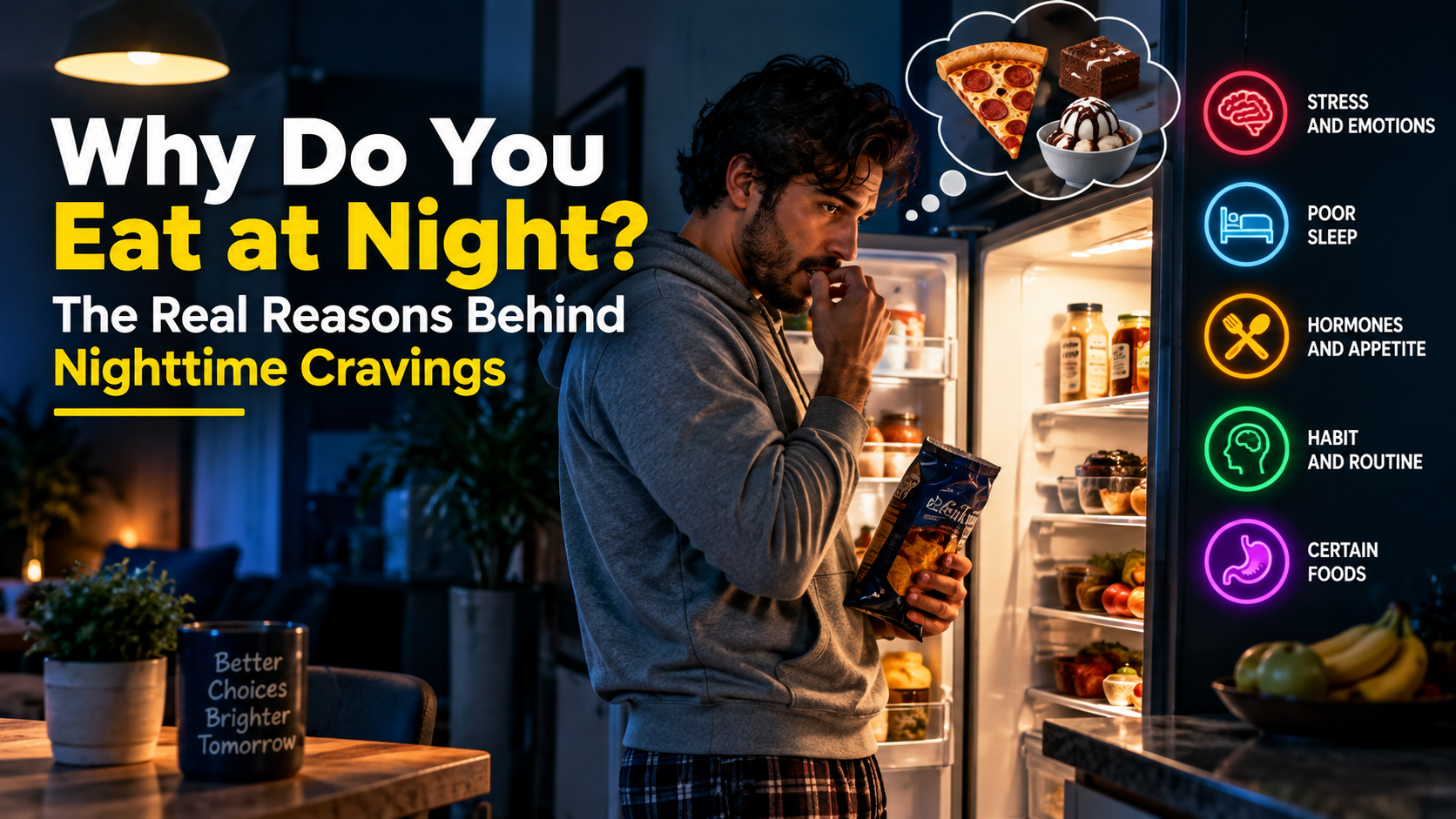
It’s 11 p.m. The house is finally completely quiet. Everyone is asleep, and there you are, standing in front of the open refrigerator, eating something you are not even really enjoying.
And while you’re doing it, that little voice inside your head starts saying:
“Again? What is wrong with me? Why don’t I have any willpower?”
I want you to hear something very carefully:
It may not be a lack of willpower.
What happens at night can have a combination of biological, behavioral, and emotional factors behind it. And once you understand them, you may stop fighting the wrong person: yourself.
Let’s take a closer look, because by the end, you’ll have several practical ideas you can start using tonight.
Part One: Fatigue
Being tired can make cravings harder to manage.
When you don’t get enough sleep or you reach the end of the day completely exhausted, the signals involved in hunger and fullness can be affected.
You may feel hungrier and have a harder time recognizing when you have had enough.
There is another factor, too.
A tired brain often looks for quick rewards.
After a long and stressful day, highly palatable foods—especially foods rich in sugar, refined carbohydrates, or fat—can become much more appealing.
That doesn’t necessarily mean you are weak.
Sometimes it simply means your brain is tired and looking for something that provides immediate pleasure or energy.
Part Two: Restricting Yourself During the Day
This is a big one.
If you spend the entire day eating very little, skipping meals, or constantly trying to suppress your hunger, nighttime can become much harder.
You may reach the evening with intense hunger and a strong desire to eat.
What feels like a nighttime “loss of control” may actually be the result of a day filled with excessive restriction.
You restricted yourself for hours, and eventually your body and mind pushed back.
That is why, for some people, the more aggressively they restrict during the day, the stronger their nighttime cravings can become.
Instead of blaming yourself for what happens at night, it can be useful to look at what happened throughout the entire day.
Part Three: Maybe You Are Hungry for Something Else
Think about when this usually happens.
Is it on a calm Tuesday when you are rested and feeling good?
Often, it happens after a difficult day.
After an argument.
When you feel lonely.
When you are bored.
When you are stressed.
Food can provide a temporary feeling of comfort and pleasure, especially when you are experiencing difficult emotions.
And your brain can learn that connection very quickly:
“When I feel bad, eating makes me feel better for a little while.”
That means you may not always be eating because of physical hunger.
Sometimes food becomes a way of coping with an emotion you haven’t learned how to handle in another way.
And I want you to remember this:
That does not make you a bad person. It makes you human.
People naturally look for ways to feel better.
The important thing is learning to recognize what you actually need in that moment.
The Real Problem
For years, many people have been told that nighttime eating is simply a matter of discipline and willpower.
So they keep fighting the same battle.
They promise themselves:
“Tomorrow will be different.”
Then nighttime comes.
They eat.
They feel guilty.
The next day, they restrict themselves even more.
And then the cycle starts again.
You may be trying to solve a problem with more discipline when what you really need is a different approach.
You may be tired.
You may not be sleeping enough.
You may be dealing with stress.
You may be reaching the evening extremely hungry.
And you may also be carrying emotions that you haven’t had the opportunity to process.
None of these things are necessarily solved by simply forcing yourself to resist.
They require attention and awareness.
Before the Plan, One Important Point
If eating feels completely out of control, happens frequently in secret, causes significant distress, or is followed by intense guilt, it may be worth speaking with a qualified healthcare professional.
Seeking support is not a sign of weakness.
It is another way of taking care of yourself.
This information is intended for general educational purposes and is not a substitute for individualized professional advice.
Now, let’s look at five practical steps.
And notice something interesting:
Most of them happen during the day, not at night.
Step One: Eat Enough During the Day
This may sound completely opposite to what you have heard.
But if you spend the entire day barely eating, it can become much harder to manage hunger later in the evening.
Try building balanced meals that include adequate sources of protein, fiber, healthy fats, and other nutrient-dense foods.
The goal isn’t to spend the entire day hungry and then try to fight your appetite at night.
The goal is to avoid reaching the evening feeling completely deprived.
Step Two: Protect Your Sleep
Sleep is also part of taking care of your eating habits.
Getting enough sleep can support normal regulation of hunger, fullness, mood, and cravings.
Sometimes the best response to a late-night craving isn’t another snack.
It may simply be getting to bed earlier.
When it is 10, 11, or 12 at night and you are exhausted, bored, or simply awake with nothing else to do, it can become much easier to start reaching for food.
Rest matters.
Step Three: Identify the Emotion
When you feel the urge to open the refrigerator, pause for a few seconds.
Ask yourself:
“Am I physically hungry, or am I trying to soothe something I’m feeling?”
Am I tired?
Lonely?
Bored?
Stressed?
Did I have a difficult day?
Simply identifying what you are feeling can create a small space between the emotion and the action.
And that small space can give you the opportunity to make a different choice.
Step Four: Give the Emotion Another Outlet
If you realize that you are not physically hungry, try another way of responding to what you are feeling.
Make a warm tea.
Call someone.
Take a shower.
Step outside for some fresh air.
Sit quietly for a few minutes.
Take several slow breaths.
This isn’t magic.
The idea is simply to give yourself more than one way to cope with difficult moments.
Food doesn’t have to be your only source of comfort.
Step Five: If You Eat More Than You Intended, Don’t Turn It Into a Disaster
This point is extremely important.
One night of eating more than you planned does not define you or erase your progress.
Try not to fall into the thought:
“I already ruined everything.”
“So tomorrow I won’t eat.”
“I have to start over.”
That kind of thinking can create another cycle of restriction and overeating.
Did you eat more than you wanted?
Okay.
It happened.
Continue normally the next day.
Punishment is not the solution.
Now Let’s Return to the Scene at the Beginning
It is 11 p.m.
You are standing in front of the refrigerator.
But the next time you find yourself there, I want you to change one question.
Instead of asking:
“Why don’t I have any willpower?”
Ask yourself:
“What do I actually need right now?”
Maybe you need rest.
Maybe you need calm.
Maybe you need connection.
Maybe you need to talk to someone.
Maybe you simply had an extremely difficult day.
And sometimes, yes, you may actually be hungry and need to eat.
The goal is to learn how to tell the difference.
Your relationship with nighttime eating may not improve through more self-punishment or stricter rules.
It can begin with adequate nutrition during the day, better sleep, greater awareness of your emotions, and a more compassionate relationship with yourself.
You don’t have to fight yourself every night.
Sometimes the first step is simply understanding what your body and mind are trying to tell you.