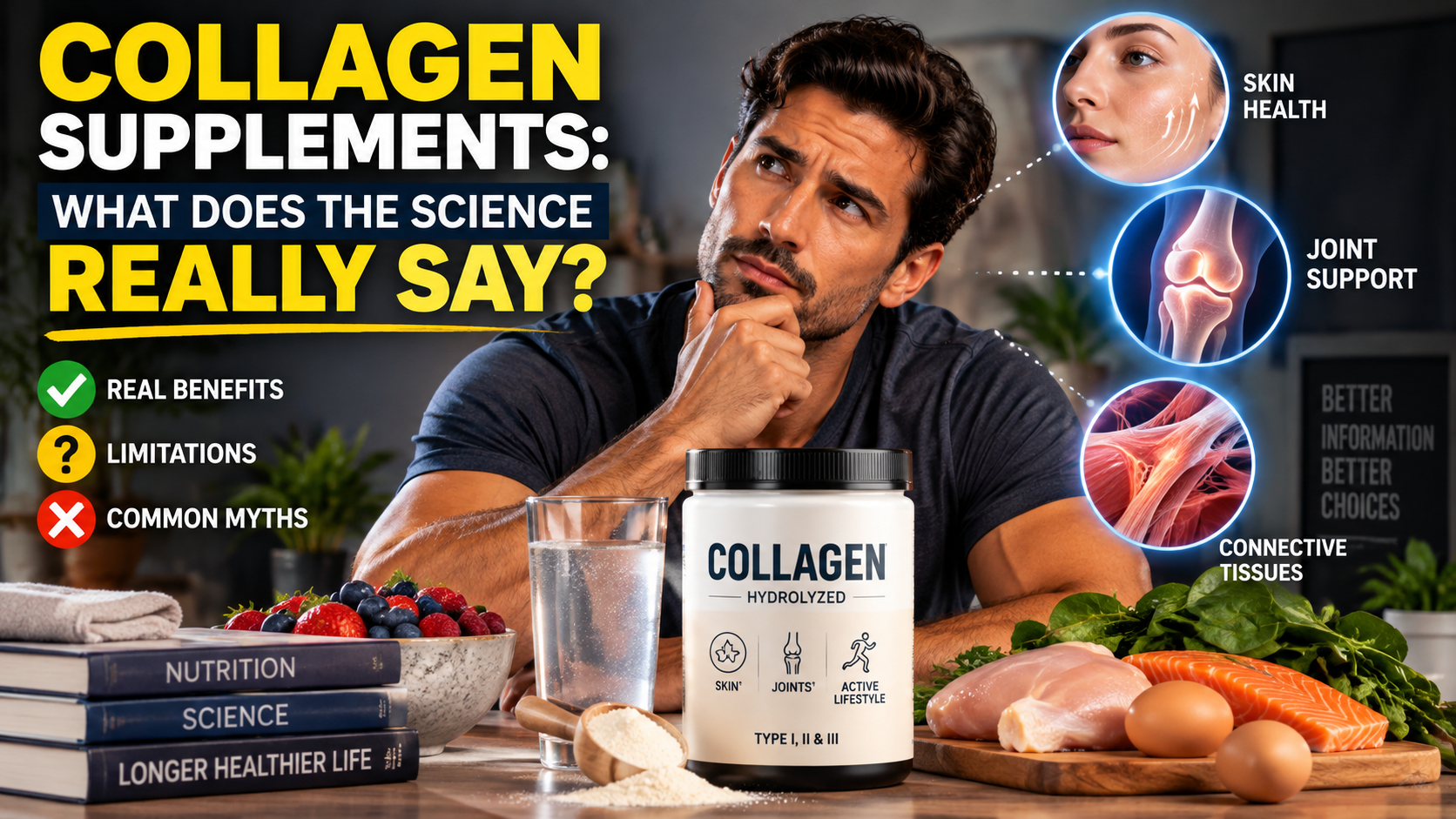
Collagen supplements are often described as either a miracle for the skin and joints or a complete waste of money.
The reality is more nuanced.
Collagen supplementation has been studied in areas such as skin hydration, skin elasticity, joint symptoms, and connective-tissue health. Some studies report modest benefits, but these effects should not be confused with a medical treatment or a guarantee of visible results.
So, does collagen actually work?
The answer depends on what type of collagen you are using, why you are taking it, the dose, the duration, and your overall nutritional and lifestyle habits.
What Happens When You Consume Collagen?
Collagen is a protein. Like other dietary proteins, it is broken down during digestion into amino acids and small peptides.
Those amino acids can then be used by the body to build and repair proteins throughout the body.
However, collagen peptides are not simply transported directly to your skin or joints and turned into collagen.
This is an important distinction.
Some small collagen-derived peptides can appear in the bloodstream after digestion, and researchers are investigating whether these peptides may act as biological signals in tissues.
The proposed mechanism is not simply that you are providing “building blocks.” Some peptides may influence cells involved in connective-tissue production, including fibroblasts.
This is one reason researchers continue to investigate hydrolyzed collagen peptides.
Hydrolyzed Collagen vs. Whole Collagen
Not all collagen supplements are formulated in the same way.
Hydrolyzed collagen, also called collagen peptides, has been processed into smaller peptide chains that are easier to dissolve and digest.
This is the form most commonly studied in oral collagen supplementation research.
However, the fact that a collagen product is hydrolyzed does not automatically mean that it will produce a noticeable benefit.
The quality of the product, the amount consumed, the study evidence behind the specific formulation, and the individual’s circumstances all matter.
Does Collagen Improve Skin?
Skin is one of the areas where oral collagen supplementation has been studied most extensively.
Several clinical trials and reviews have reported modest improvements in measures such as skin hydration and elasticity, with some studies also reporting changes in the appearance of fine wrinkles.
These findings do not mean that collagen works like Botox or produces a dramatic transformation.
The potential effect is much more subtle and relates to the structure and properties of the skin.
It is also important to recognize that studies vary considerably in their methods, collagen products, doses, and duration.
Therefore, collagen should be viewed as a possible nutritional supplement rather than a guaranteed anti-aging treatment.
What About Joints?
Collagen has also been studied for joint health, particularly in people experiencing exercise-related or degenerative joint discomfort.
Some research suggests that certain collagen preparations may modestly reduce joint pain or improve joint-related symptoms in some individuals.
One preparation that has received particular attention is undenatured type II collagen, commonly referred to as UC-II.
UC-II is different from typical hydrolyzed collagen peptides and has been investigated for joint-related outcomes through a different proposed mechanism.
However, it should not be described as a cure for arthritis, cartilage damage, or chronic inflammation.
People with persistent or significant joint pain should seek an appropriate medical evaluation rather than relying on supplements alone.
Does Your Body Need Vitamin C to Make Collagen?
Yes.
Vitamin C plays an essential role in normal collagen synthesis.
Without adequate vitamin C, the body’s ability to produce normal collagen is impaired.
This does not mean that taking collagen together with large amounts of vitamin C will automatically produce better results.
For most people, the important point is simply to maintain adequate vitamin C intake through a balanced diet.
Foods such as citrus fruits, berries, peppers, broccoli, tomatoes, and other fruits and vegetables can provide vitamin C.
What About Other Nutrients?
Collagen production requires more than collagen supplements.
The body needs adequate protein and a variety of nutrients to maintain and repair tissues.
Amino acids such as glycine and proline are abundant in collagen, but the body obtains amino acids from the overall protein intake in the diet.
Other nutrients, including copper and zinc, also participate in normal connective-tissue metabolism.
This is why a supplement cannot compensate for an inadequate overall diet.
If someone has poor nutrition, inadequate protein intake, insufficient sleep, or other health problems, simply adding collagen is unlikely to solve the underlying issue.
Is Cheap Collagen Automatically Bad?
Price alone does not tell you whether a collagen supplement is effective.
Instead of judging a product simply by how expensive or inexpensive it is, look at the information provided by the manufacturer.
Important questions include:
- Is it hydrolyzed collagen or collagen peptides?
- How much collagen does each serving provide?
- What type of collagen is included?
- Are the ingredients clearly listed?
- Does the manufacturer provide quality-control information?
- Has the specific formulation been studied in humans?
A more expensive product is not automatically better, and a cheaper product is not automatically useless.
Do You Need Multiple Types of Collagen?
There are many types of collagen in the human body, with different structural and biological roles.
However, the idea that everyone needs a supplement containing several collagen types is not established as a universal rule.
Different collagen formulations have been studied for different purposes, but more ingredients do not automatically mean better results.
If the goal is skin health, the relevant research may involve different preparations than research focused on joint health.
The important question is not simply how many collagen types appear on the label. It is whether the specific product and dosage have meaningful evidence behind them.
Can Collagen Reduce Inflammation?
This claim requires caution.
Some studies have investigated potential effects of collagen supplementation on inflammatory or joint-related markers, but collagen should not be considered a general anti-inflammatory treatment.
If someone has active inflammation caused by an underlying medical condition, treating the cause is much more important than taking a collagen supplement.
Collagen is a nutritional supplement, not a replacement for appropriate medical care.
How Long Does Collagen Take to Work?
Collagen is not an instant solution.
Studies investigating skin and joint outcomes have generally evaluated supplementation over several weeks or months rather than a few days.
If a person chooses to try collagen, consistency is more relevant than expecting an immediate transformation.
At the same time, not everyone will notice a meaningful difference.
Individual responses can vary, and some people may experience little or no noticeable benefit.
So, Is Collagen a Scam?
Calling collagen either a complete scam or a miracle supplement oversimplifies the evidence.
There is scientific research supporting potential benefits in certain areas, particularly skin-related outcomes and some measures of joint discomfort.
But the effects are generally modest, the research is not uniform, and collagen cannot replace a balanced diet, resistance training, adequate sleep, or appropriate medical treatment.
The best way to think about collagen is as a possible supplement that may provide an additional benefit for certain goals—not as a magic solution.
The Bottom Line
If your diet already provides enough protein and you eat a varied diet rich in fruits, vegetables, whole foods, and essential nutrients, collagen is optional rather than essential.
If you are interested in trying it, look for a clearly labeled collagen-peptide or hydrolyzed-collagen product, check the serving amount, and consider whether there is human research supporting the intended use.
For joint-specific products, pay attention to the exact form of collagen being used because different preparations are not interchangeable.
Most importantly, keep your expectations realistic.
Healthy skin, strong joints, and connective tissue depend on many factors. A supplement can potentially contribute, but it cannot replace the foundation of good nutrition, physical activity, recovery, and appropriate healthcare.
Collagen is neither magic nor necessarily useless.
The science suggests something much more interesting: it may help in specific circumstances, but the size of the benefit and the people who benefit most are still areas of ongoing research.